Does My Windshield Require ADAS Calibration?
Vehicles Most Likely to Require Windshield Calibration
If your vehicle is a 2018 model year or newer from any major manufacturer, there is a strong probability it requires ADAS calibration after windshield replacement. These are the most common makes and model lines seen throughout Amsterdam and the Capital Region that will almost always require it:
- Toyota and Lexus vehicles with Toyota Safety Sense, standard on most models since 2018, include pre-collision warning, lane departure alert, and radar cruise control through the windshield camera.
- Honda and Acura vehicles with Honda Sensing, standard on most models since 2018, include collision mitigation braking, road departure mitigation, and lane keeping assist.
- Subaru vehicles with EyeSight use a stereo camera mounted at the top of the windshield and are among the most calibration-sensitive vehicles on the road.
- Ford and Lincoln vehicles with Ford Co-Pilot360 include automatic emergency braking, lane keeping, and evasive steering assist tied to a forward windshield camera.
- Chevrolet, GMC, and Buick vehicles with forward collision alert, automatic emergency braking, and lane keep assist packages run through forward-facing camera systems.
- Volkswagen and Audi vehicles with Front Assist and lane departure systems mounted to the windshield.
Craftsman Auto Glass confirms the specific requirements for your year, make, model, and trim before any work begins so there is no guesswork going into the appointment.
The Safety Features That Connect to Your Windshield Camera
The forward-facing camera mounted behind the rearview mirror powers several of the most important safety systems on a modern vehicle. When the windshield is replaced, that camera's reference baseline changes, which is why calibration is required before those systems function accurately again.
- Automatic Emergency Braking detects vehicles and pedestrians ahead and applies the brakes when a collision is imminent and the driver has not responded.
- Lane Departure Warning and Lane Keeping Assist track lane markings through the camera. Lane departure warning alerts the driver when the vehicle drifts across a line without a signal. Lane keeping assist applies a steering correction to guide the vehicle back.
- Adaptive Cruise Control monitors the vehicle ahead and automatically adjusts speed to maintain a set following distance.
- Forward Collision Warning tracks closing speed relative to the vehicle ahead and alerts the driver before the situation becomes critical.
- Traffic Sign Recognition reads posted speed limits and road signs and displays them on the instrument cluster or head-up display.
What Skipping Calibration Actually Does
Skipping calibration does not disable the safety features. It leaves them running on reference points that no longer match reality. Lane departure warnings may trigger on straight roads with no drift present. Adaptive cruise control may not maintain a steady following distance. Automatic emergency braking may activate late or not at all. The vehicle can look and feel completely normal while the systems designed to keep it safe are operating on incorrect data.
A Brief History of ADAS Technology
Advanced Driver Assistance Systems developed gradually over several decades. Early versions appeared in the 1970s with anti-lock braking and expanded through the 1990s and 2000s with traction control and electronic stability systems. Forward-facing cameras capable of reading lane markings and detecting vehicles became commercially available in the early 2010s, starting as premium options on luxury models before filtering down to mainstream vehicles.
The shift accelerated in 2016 when a coalition of major automakers committed to making automatic emergency braking standard across most new vehicle lines by 2022. Today, the majority of new vehicles sold in the United States come equipped with at least one ADAS feature tied to a forward-facing windshield camera, making calibration after replacement a routine part of auto glass service across the Capital Region.
Static vs. Dynamic Calibration
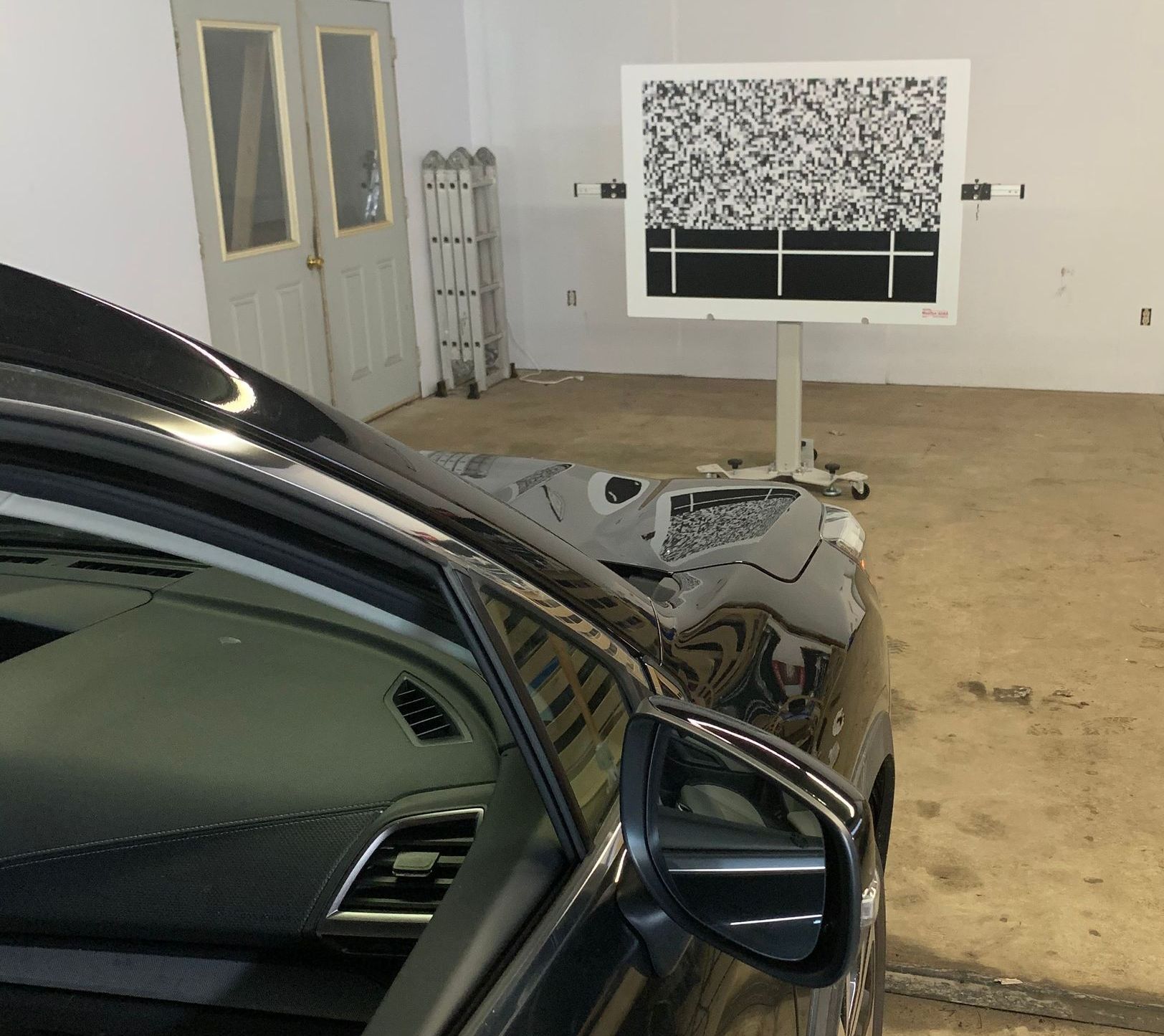
Calibration falls into two categories depending on the vehicle. Static calibration is performed with the vehicle stationary using certified targets positioned at precise distances in front of the car. Dynamic calibration is performed while the vehicle is driven under controlled conditions so the system gathers live road data. Some vehicles require one method; others require both. Craftsman Auto Glass confirms which applies before the appointment begins and provides a clear time estimate upfront.
Using Insurance for Windshield Replacement & Calibration in New York
New York is not a zero-deductible state for windshield replacement, so most drivers pay their standard comprehensive deductible when filing a glass claim. Most major insurance providers cover ADAS calibration as part of that claim when the vehicle requires it. Craftsman Auto Glass handles the insurance claims process directly and can clarify what your specific policy covers before scheduling.
ADAS Calibration in Amsterdam & The Capital Region of New York
Craftsman Auto Glass has been serving the Capital District for over 10 years with certified windshield replacement and ADAS calibration from our Amsterdam location. In-shop and mobile service are both available, and every replacement is backed by a lifetime guarantee against defects and leaks. Contact Craftsman Auto Glass today for a free quote on your ADAS calibration service in Amsterdam, Johnstown, Ballston Spa, and Schenectady.